

Two casino lobbies can advertise what appears to be the same slot: identical artwork, the same developer and the same bonus features. Yet the mathematics behind the game may not be identical. Some online slots are distributed with several approved return-to-player (RTP) configurations, and the difference can be more meaningful than a new theme or a larger headline prize.
Understanding those versions matters for anyone comparing games across websites. It also helps separate useful technical information from the common misconception that an attractive RTP percentage predicts what will happen during the next twenty spins.
RTP is a long-run parameter, not a session forecast
Return to player expresses the theoretical share of total stakes that a game is designed to pay back over a very large volume of play. A slot set to 96% RTP has a theoretical house edge of 4%. At 94% RTP, the corresponding edge is 6%. That two-percentage-point RTP gap is a 50% increase in the mathematical advantage retained by the house, even though both figures may look similar at first glance.
For an illustration, imagine £1,000 of cumulative stakes, including money wagered again after a win. At a theoretical 96% RTP, the expected return is £960; at 94%, it is £940. The £20 difference is an expectation calculated across many outcomes, not the result an individual can count on. Importantly, £1,000 in turnover does not necessarily mean depositing £1,000; money can be wagered repeatedly.
The UK Gambling Commission’s explanation of RTP makes the same central distinction: return-to-player percentages describe averages across substantial numbers of games, not a payment promise for each session.
Why can a single title have different RTP versions?
In markets where it is permitted, a game supplier may make more than one preconfigured mathematical version available to operators. A casino can then offer an approved configuration suited to its commercial and regulatory environment. This is different from an operator changing the odds after each individual spin; players should check the version displayed by the actual game they are using rather than assuming every casino hosts identical mathematics.
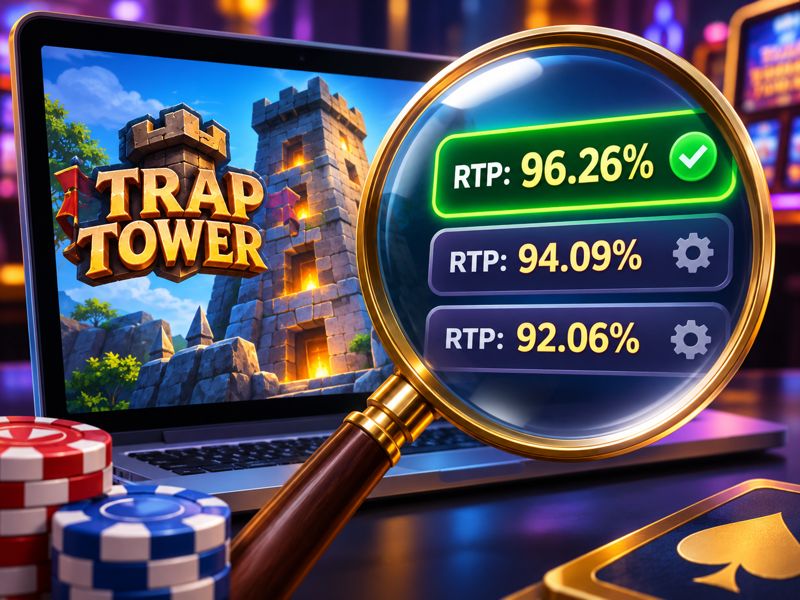
A concrete illustration comes from Trap Tower, which is listed with a headline RTP of 96.26% and alternative RTP settings of 94.09% and 92.06% in its published game information. The free slot game catalogue at SpinCastle contains individual game descriptions and technical details that provide a useful starting point for recognising such differences. The decisive source for a specific real-money session remains the game information or paytable within the licensed operator where that session takes place.
Those three illustrative RTP settings imply theoretical house edges of 3.74%, 5.91% and 7.94% respectively. Put another way, the highest-edge version has more than twice the theoretical advantage of the lowest-edge version. A comparison that stops at matching names and screenshots can miss this distinction entirely.
Volatility is a separate dimension
RTP alone does not tell you how often a game will pay or how widely individual results can swing. Volatility describes the spread of outcomes: lower-volatility games tend to deliver smaller prizes more frequently, whereas high-volatility games can concentrate a larger share of returns in rare, substantial wins. Two slots can have the same RTP and feel very different in the short term.
The distinction also matters when someone reports that a slot “paid well” or “never paid anything”. A small set of spins is not reliable evidence that the published RTP is wrong. The regulator’s technical definitions for theoretical RTP, actual RTP and volatility expressly distinguish the mathematical design of a game from the payout percentage observed in a limited period.
A higher RTP is mathematically preferable when comparing otherwise equivalent games, but it is not a shield against a losing session. A high-volatility slot set to 97% can still go a long time without a notable win. No published percentage abolishes randomness or eliminates the operator’s long-run advantage.
What free-play demos can—and cannot—show
Demo play is useful for learning the interface: identifying paylines, reading the paytable, understanding how wild symbols interact and seeing whether bonus-round mechanics are intuitive. It also helps distinguish a simple three-reel game from a feature-heavy title with expanding reels, multipliers or bonus-buy mechanics.
However, a short demo is a poor test of RTP. Fifty or even five hundred spins are nowhere near enough to establish a dependable long-run average for a volatile game. More importantly, a demo hosted on an information website should not be assumed to have the same settings as every real-money implementation. Readers comparing casinos should verify which mathematical configuration the operator actually discloses.
The game screen’s help menu, information panel and paytable are therefore more useful evidence than the outcomes of one demonstration. If an operator or game does not disclose the information needed to understand the rules, that is a reason to investigate further rather than infer the missing figures from experience.
Licensing and game design are different questions
An RTP comparison does not establish whether a casino is authorised to serve someone in their country. Rules about licensing, technical testing, payment methods and permitted game features differ across jurisdictions. A site’s brand recognition is not a substitute for checking the relevant regulator’s public information.
Likewise, an attractive bonus or a large advertised maximum win should not be treated as evidence that the underlying game is favourable. Wagering conditions, stake limits, withdrawal rules and the exact RTP version can each affect the overall proposition. These are separate questions, and none should be hidden behind a single “best slot” ranking.
A practical five-point comparison
- Confirm the exact game title and provider. Similar artwork or familiar mechanics can conceal different editions of a game.
- Find the RTP in the live game information. Treat a third-party review as a guide, then check the operator’s own version.
- Compare house edges, not just headline RTPs. A shift from 96% to 94% increases the theoretical edge from 4% to 6%.
- Read the volatility and feature rules. Bonus mechanics, maximum wins and prize frequency describe aspects of risk that RTP alone cannot.
- Verify the operator’s legal status and limits. Confirm that the service is permitted in your jurisdiction and set a spending limit before playing.
The number that deserves more attention
The strongest comparison is not between the prettiest games, nor between the loudest promotions. It is between clearly identified versions with transparent rules. RTP explains the game’s long-term design, volatility explains why sessions can diverge so dramatically from that average, and licensing determines where the game may lawfully be offered.
A few minutes spent reading the actual paytable and the operator’s published terms gives players more useful information than trying to interpret a winning or losing streak. That remains true whether the game is played for free or for money. Gambling should be treated as paid entertainment, never as a reliable source of income.